

SEP and SIMPLE IRA benefits: How contributing early can help small business owners

Many small business owners think about retirement plans the same way they think about taxes, something to deal with right before the deadline. It’s common to wait until tax season to consider SEP IRA benefits or SIMPLE IRA benefits, once the numbers are final and the pressure is on.
But retirement contributions don’t have to be a last-minute task. Funding earlier in the year supports cash flow planning, spreads out contributions, and gives your money more time to work for you. It’s important to note that while employer contributions for SEP and SIMPLE IRAs are generally due by the tax filing deadline, SIMPLE employee salary deferrals must be deposited on a timely basis under Internal Revenue Service and Department of Labor rules.
This approach can be especially helpful for small business owners evaluating SEP IRA or SIMPLE IRA retirement plans, as well as advisors supporting employer retirement strategies.
The power of contributing early to SEP and SIMPLE IRAs
Timing plays a bigger role in retirement planning than many realize, especially when it comes to investing and compound growth.
Time in the market, not timing the market
Planting a seed at the start of the growing season gives it more time to take root and grow, than seeds planted right before harvest. The same idea applies to retirement contributions. Early SEP IRA and SIMPLE IRA contributions give retirement assets more time to participate in market movement, which may support long term growth depending on market conditions.
For example, if you start contributing monthly in January instead of waiting until a tax deadline the following April, your investments have roughly 15 additional months in the market. You’re contributing the same amount, but investing it longer, which may support growth over time, depending on market conditions.
It’s important to note that market performance varies, and growth is never guaranteed.
Smaller deposits, less pressure
Instead of making one large contribution at tax time, spreading contributions across the year can feel more manageable. This approach may help smooth out cash flow and reduce the stress of a single, lump-sum payment.
A steadier approach to investing
Monthly contributions can support a steadier investing approach called dollar cost averaging, which means investing regularly over time rather than putting all your money in at once.
Think of it like buying supplies for your business throughout the year instead of making one large purchase on a single day. Some months, prices are higher; other months, prices are lower. When you buy a little at a time, your overall cost reflects a mix of those prices.
The same idea can apply to investing. Over time, this approach may help reduce the impact of short‑term market swings1.
Unpacking SEP IRA benefits for employers
A simplified employee pension (SEP) IRA is designed for simplicity and flexibility, especially for small businesses with few or no employees.
High contribution potential
One of the key advantages of a SEP IRA is the ability for employers to make relatively high contributions compared to many other retirement plan options, within IRS limits. The employer makes all contributions; employees do not contribute a portion of their own pay.
When you choose to contribute to a SEP IRA, contributions are based on a percentage of compensation for that year. That same percentage must be applied consistently to all eligible employees, including you as the business owner.
This structure may be ideal if you operate an owner-only business or if you want the option to save more for retirement in stronger income years.
For 2026, employers can generally contribute up to 25 percent of an eligible employee’s compensation to a SEP IRA, up to a maximum of $72,000 for that year2.
Built-in flexibility from year to year
SEP IRAs also offer flexibility from one year to the next. You decide whether to contribute each year and how much to contribute, within IRS limits. There is no requirement to contribute every year.
This flexibility allows contributions to adjust with your cash flow. In a strong year, you may choose to contribute more. In a slower year, you may reduce contributions or skip them altogether.
Simple administration
Compared to many other retirement plans, SEP IRAs are straightforward to set up and maintain. They do not require annual nondiscrimination testing, a process used in some retirement plans to confirm that contributions do not unfairly favor business owners or higher-paid employees.
In practical terms, that means fewer administrative steps and less ongoing oversight. For you as the small business owner, this can translate to less paperwork, fewer compliance tasks, and more time focused on running your business.
Better cash flow planning
Contributing early or spreading SEP IRA contributions across the year can make retirement savings easier to manage alongside day-to-day business expenses. Instead of facing one large contribution at tax season, you may prefer to plan contributions in smaller amounts that fit more naturally into monthly cash flow.
SIMPLE IRA benefits for growing teams
A savings incentive match plan for employees (SIMPLE) IRA may be an ideal fit if you want employees to actively save for retirement.
Employees can contribute, too
Unlike a SEP IRA, a SIMPLE IRA allows employees to make salary deferrals from their paychecks. This shared approach to saving can support participation and engagement across your team.
Employee contribution limits
| Employee W-2 compensation | Contribution limit |
| Under age 50 | $17,000 |
| Age 50-69 and 64+ | $21,000 |
| Age 60-63 | $22,250 |
Age 60-63 super catch-up contribution limits apply only if the plan sponsor elects increased deferral limits under SECURE 2.0 and eligibility requirements are met. These figures reflect the basic contribution limits. Additional or higher limits may apply under SECURE 2.0 based on plan size or choices made by the plan sponsor.
Predictable employer contributions
You are required to contribute each year, either through a dollar-for-dollar match (up to a set percentage) or a non-elective contribution. While this adds structure, it also creates predictability for budgeting.
- Matching contribution option: The employer can match each employee’s salary deferral dollar-for-dollar, up to 3 percent of that employee’s compensation for the year. The employee must contribute to the plan to receive a matching employer contribution.
- Nonelective contribution option: The employer may choose to contribute 2 percent of compensation for each eligible employee, whether or not the employee contributes.
SIMPLE IRA employer contribution options example
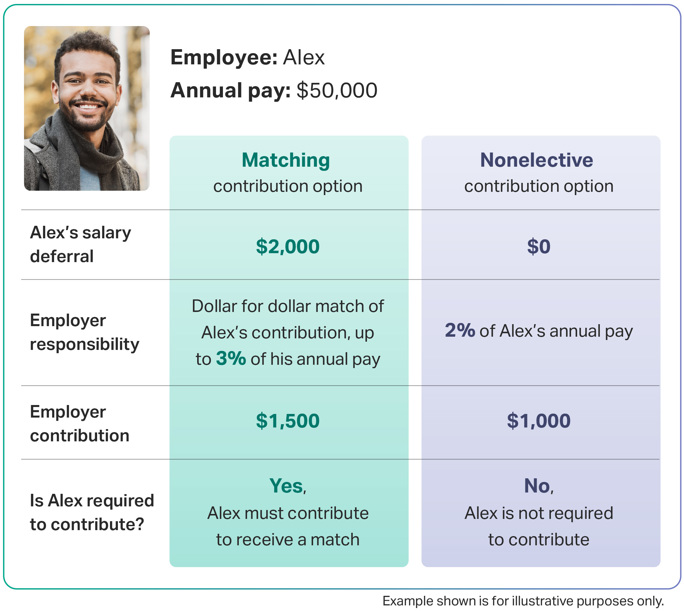
The above example is for illustrative purposes only. SIMPLE IRA contribution rules and limits are set by the IRS and are subject to change. Actual contributions depend on plan design, compensation, and employee participation.
Designed for growing businesses
SIMPLE IRAs are available to businesses with up to 100 employees, making them a common next option for companies that have outgrown an owner-only plan but don’t want the complexity of a 401(k).
Recent updates under SECURE 2.0
Recent legislation expanded catch‑up contributions, designed to help people who are closer to retirement save more. With a SIMPLE IRA, eligible employees can contribute up to $17,000 from their pay in 2026. Employees who are age 50–59 or 64 and older may contribute an additional $4,000 as a catch‑up.
Those ages 60–63 may be eligible for a higher “super catch‑up” contribution of $5,250, if the employer’s plan adopts the SECURE 2.0 higher‑limit option3.
Comparing SEP IRA vs. SIMPLE IRA plan features
Choosing between a SEP IRA and a SIMPLE IRA often comes down to how your business operates today, and where it’s headed.
| SEP IRA | SIMPLE IRA | |
| Who contributes | Employer only | Employer + employee |
| May be ideal for | Sole proprietorships and businesses with few employees | Businesses with up to 100 employees |
| Eligible businesses | Any employer may establish | Any employer that has less than 100 employees and does not maintain another retirement plan may establish |
| Employee contributions | Generally, not allowed | Up to $17,000 in 2026 |
| Employer contributions | Up to 25% of compensation, maximum of $72,000 | Match up to 3% of pay or 2% of pay nonelective |
| Flexibility | Contributions are optional year-to-year. If a contribution is made, it must be made for all eligible employees using the same percentage. | Employer contributions are required each year. |
Both options allow for tax-deductible employer contributions, and both can benefit from early, planned funding rather than last-minute decisions.
The advisor’s role: guiding the conversation
For advisors, early funding conversations can shift retirement planning from a tax-season transaction to year-round discussion. Starting earlier gives advisors more room to help clients think strategically and connect retirement contributions to everyday business decisions, like managing cash flow, supporting employees, and planning for growth.
As companies grow, changes in revenue or staffing can signal that it may be time to move from a SEP or SIMPLE IRA to a 401(k). Advisors and business owners can evaluate whether the current plan still fits and compare options thoughtfully when these conversations happen outside of busy tax season.
Easier onboarding and plan setup
Working with a provider like Ascensus that offers technology-supported retirement plan solutions can streamline advisor retirement plan onboarding by aligning plan design, contribution strategy, and payroll processes, simplifying plan setup.
Early planning can also reduce last minute changes, corrections, or rushed decisions.
Start your plan year strong
As a business owner, you’re balancing a lot. Often, the challenge with retirement planning isn’t whether to save for retirement, but how to do it in a way that fits the realities of running your business. Contributing earlier or spreading contributions across the year can help ease tax‑season pressure and support more consistent cash‑flow planning.
Understanding SEP IRA benefits and SIMPLE IRA benefits goes beyond contribution limits or potential tax advantages. It’s also about how each plan fits your business model, including who contributes, when contributions are made, and how much flexibility you have as income changes. What works well for an owner‑only business today may look different as your team grows.
If you’re exploring retirement plan options or reassessing whether your current plan still fits, working with an advisor and choosing flexible, technology‑supported solutions can help you evaluate your choices and adapt as your business evolves.
Explore SEP and SIMPLE IRAs to see which option may fit your business goals.
1Dollar cost averaging does not guarantee a profit or protect against loss. All investing involves risk, including the possible loss of principal.
2Contribution rules and limits are set by the IRS and are subject to change.
3Age 60-63 super catch-up contribution limits apply only if the plan sponsor elects increased deferral limits under SECURE 2.0 and eligibility requirements are met. These figures reflect the basic contribution limits. Additional or higher limits may apply under SECURE 2.0 based on plan size or choices made by the plan sponsor.
